
Exhaustive search without the algorithm.
Search your channel without opening Studio. Your whole catalog as notes on your own disk — full text, instant, offline, and across every channel and show you manage at once.
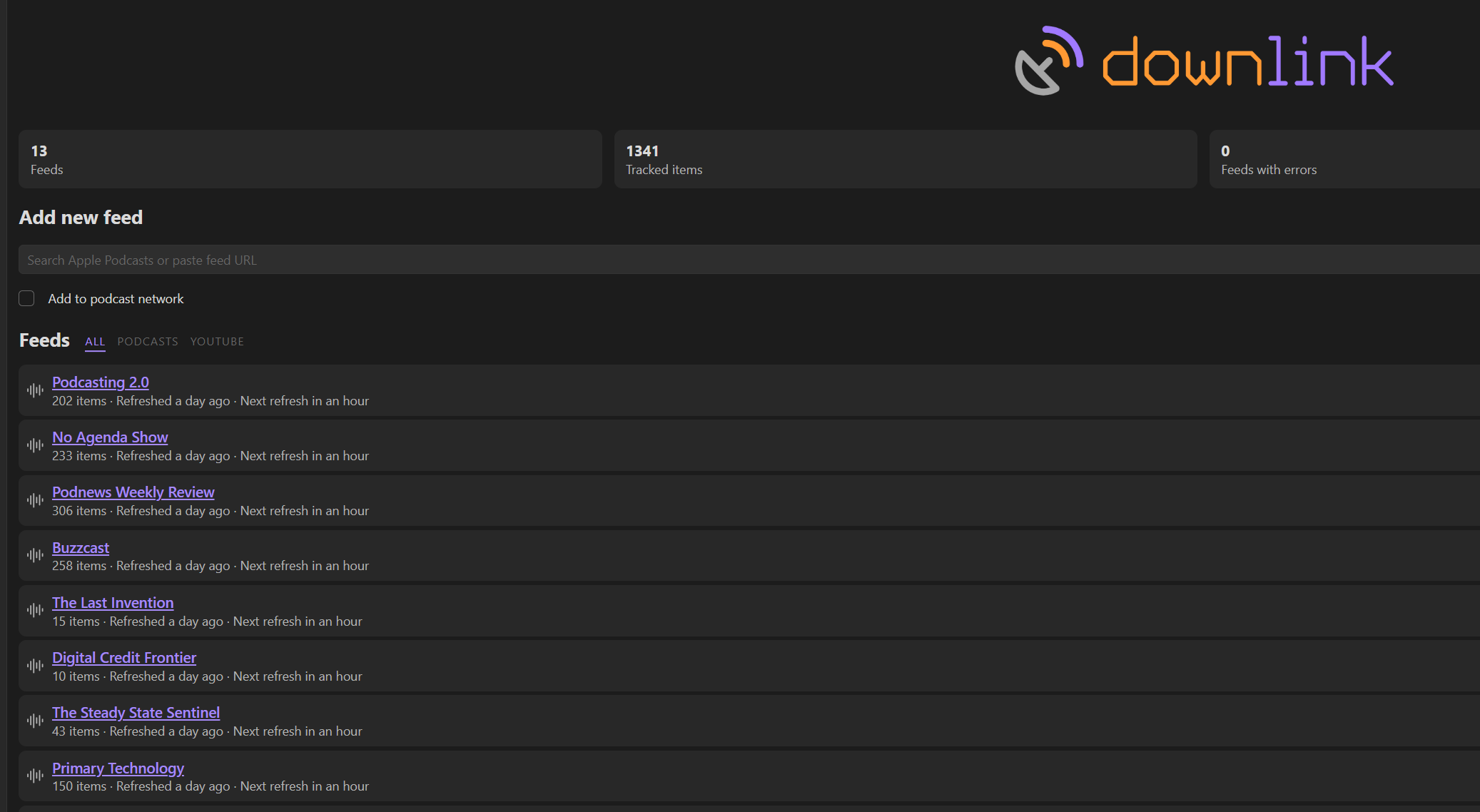
Channels sit in the same feed list as shows — one dashboard, both platforms.
Why a key
YouTube's public feed carries almost nothing.
In the RSS feed
A title, a channel URL, and the 15 most recent videos. No avatar, no handle, no description, no country, no subscriber, video or view counts.
Downlink still uses it — as the cheap signal for when something new goes up.
With your Data API v3 key
The rest of it: descriptions, handles, artwork, counts, and the back catalog past those 15 videos. Shorts are yours to include or leave out.
Official endpoints only. Downlink does not scrape, and never has.
Your keys
Held in Obsidian, not by us.
Keys live in Obsidian's encrypted keychain, never in a plugin config file and never in anything that syncs with your vault. They are read at the moment of use, so revoking one takes effect immediately.
Your catalog
A channel is a folder of notes.
Every video becomes a Markdown file with structured frontmatter, so Bases can turn a channel into a table you filter by date, playlist, collaborator or anything else you record.
Captions
Transcripts for the channels you own.
How it works
Caption tracks are not public data. Downlink reaches them by signing you in to Google with OAuth, so YouTube grants access on the strength of your own channel ownership — not a key, and not a scrape.
Once connected, captions come down alongside the rest of the metadata and land in the note body, leaving every word of every video searchable in your vault.
What it covers
Channels your Google account owns or manages. Other people's videos stay limited to what the API and feed already give you.
The token is held the same way your API key is — in Obsidian's encrypted keychain, read at the moment of use. Revoke it from your Google account and ingestion stops on the next run.
Questions
Read the full FAQWhy do I need my own API key?
Because YouTube's public feed carries a title, a channel URL and the 15 most recent videos — no handle, description, artwork or counts. With a Data API v3 key, Downlink can read the rest, including the back catalog past those 15 videos.
Where is my key stored?
In Obsidian's encrypted keychain — never in a plugin config file, and never in anything that syncs with your vault. Keys are read at the moment of use, so revoking one takes effect immediately.
Does Downlink scrape anything?
No. Official endpoints only, and it never has. Shorts are yours to include or leave out.
Where does my catalog actually live?
On your computer, as Markdown files in your vault. A channel is a folder of notes; every video is a file with structured frontmatter, so Bases can turn it into a table you filter however you like.
Stop searching your own channel from the outside.
Downlink is in private beta. Join the waitlist and we'll email you when it's available.
Join the waitlist